


The Screen Time Conversation We’re Not Having
“Productive screen time for toddlers”, what even?!
I’ll never forget sitting in my son’s occupational therapy waiting room, scrolling through my phone, when I overheard a parent two seats over say: “I just took away all screens. Cold turkey. That’s what the pediatrician said.”
The other parent nodded like this was wisdom handed down from a mountain. And look — I get it.
Every headline you see is some variation of screens are melting your child’s brain.
The messaging is relentless, and it’s terrifying when you’re trying to do right by your kid.
But here’s what nobody in that waiting room was talking about: not all screen time is the same. At all.
There’s a world of difference between a toddler passively watching an autoplay YouTube spiral for two hours and a child actively engaged in something that demands their eyes, their hands, and their brain to work in sync — all at the same time. One is numbing. The other is, genuinely, training.
This post is about the second kind.
What Reaction Time Actually Means for Young Children
Reaction time isn’t just a sports metric. It’s a core cognitive function that develops rapidly between ages two and seven — and how it develops has lasting implications for attention, academic readiness, and even emotional regulation.
Here’s the simple version: reaction time is the gap between a stimulus (something your child sees or hears) and their physical response to it. In toddlers and young children, that gap is longer than in adults — naturally. The prefrontal cortex is still building the neural highways that allow for quick, accurate, coordinated responses.
Why This Window Matters
The early years aren’t just important for language and social development. They’re also a critical period for what researchers call sensorimotor integration — the brain’s ability to coordinate sensory input with motor output. Think of it like your child’s nervous system learning its own grammar.
When a three-year-old reaches for a cup and misjudges the distance, or swings at a ball and misses by six inches, that’s not clumsiness — that’s a brain in the middle of a very complex calibration process. The more varied and active that process is, the more efficiently those neural pathways mature.
Where Screen Time Fits In
Traditional screen time gives a child nothing to do but watch. Purposeful screen time — the kind built around timing, coordination, and visual tracking — gives that developing brain something to actively respond to. The distinction matters enormously, and the research is catching up to what many parents are already intuiting.
The Science: How Purposeful Screens Build Neural Pathways (toddler screen time benefits)
Let’s get specific about what’s actually happening in a young child’s brain during different kinds of screen engagement.
Passive vs. Active Engagement
Passive viewing activates relatively limited neural circuitry — primarily the visual cortex processes the content, and the child receives without responding. There’s a reason pediatric researchers flag this as low developmental value for very young children: the brain isn’t being called to do anything.
Active, response-based screen engagement is a different picture entirely. When a child must watch a moving object and respond to it with a precise physical action — especially under time pressure — they’re recruiting attention networks, working memory, visuospatial processing, and motor planning all at once. Research has linked this kind of multimodal engagement to improvements in sustained attention, processing speed, and hand-eye coordination in early childhood populations.
A 2019 study in Frontiers in Psychology found that action-based gaming tasks significantly improved attentional control in children ages five to eight, effects that transferred to non-gaming tasks as well. This isn’t about gaming being magic — it’s about what the task demands of the brain.
The Role of Timing and Precision (reaction time activities for kids)
Here’s the thing about precision-based tasks: they’re honest. There’s no random luck component. A child either releases at the right moment or they don’t. That kind of clear, immediate feedback loop is exactly what builds what researchers call error-monitoring — the brain’s ability to detect mistakes and self-correct.
Children who develop strong error-monitoring early show better academic outcomes and stronger impulse control. You don’t build that capacity by watching a show. You build it by doing something where timing actually matters.
Click Here To Improve Your Response and Reaction Time. (Link to download Fast Reflex Improvement Game for Android from Google Play Store) (focus games for young children)
Practical Strategies for Productive Screen Time
Alright — enough theory. Here’s what actually works, based on both the research and what I’ve seen families try successfully.
1. Set a Purpose Before the Screen Goes On
This sounds too simple, but it changes everything. Before your toddler or young child picks up a device, name what you’re doing. “We’re going to practice your quick hands for five minutes.” That framing shifts the child’s orientation from passive consumption to active participation.
2. Choose Activities That Demand a Physical Response
Not all apps marketed as “educational” require genuine engagement. Look for activities where your child must react to something on screen — where there are clear right and wrong moments to respond, and where the difficulty adjusts as they improve. Flat, predictable games with no timing element or consequence for errors are closer to passive viewing than they appear.
3. Use Short Sessions Before Focus-Dependent Tasks
Several parents I’ve worked with have found that five to ten minutes of high-attention screen activity before homework or quiet reading time creates a kind of focus bridge. Their children arrive at the task in a more regulated, attentive state. This aligns with what neuroscientists describe as arousal regulation — brief, engaging activity can bring an underaroused nervous system to an optimal state for learning.
In my work with families, I’ve found that activities requiring focused attention and quick responses — like certain coordination-based games — can help strengthen this transition window noticeably. The practice of rapidly responding to visual cues while coordinating hand movements appears to engage the same executive function networks that support attention regulation and impulse control in young children.
4. Watch Together Sometimes
Co-viewing or co-playing transforms screen time into a relational, conversational activity. Ask your child: “Did you do it in time? What do you think you’ll try differently?” That metacognitive conversation — thinking about thinking — is one of the highest-value things a parent can do during any activity.
5. Balance Screen-Based Reaction Training With Physical Equivalents
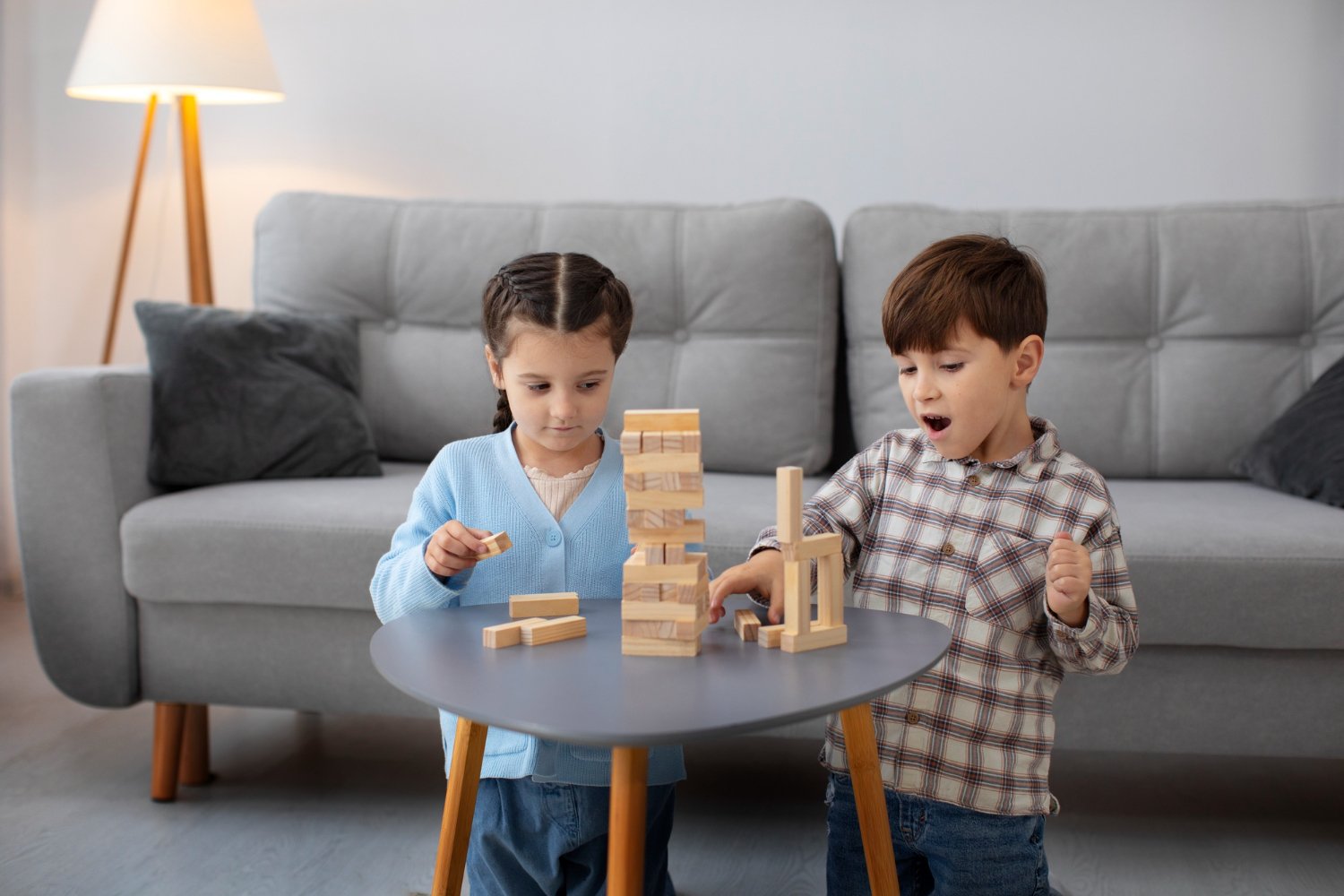
Catching balls, pouring water, stacking blocks with a timer, Simon Says — these are the offline cousins of screen-based reaction training. The neural benefits compound when children practice the same underlying skills across different contexts. Screens don’t replace physical play; they extend and reinforce it.
6. Build a Consistent Ritual, Not a Reward System
When screen time becomes a reward, it gets loaded with emotional weight that makes it harder to regulate. When it’s simply part of the daily routine — “after school snack, then five minutes of focus time, then homework” — children engage with it more calmly and transition away from it more easily.
What to Avoid: The Screen Time Traps
Just as important as what works is knowing what doesn’t.
Autoplay anything. The moment content autoplays, you’ve lost the attention-activation element entirely. Your child stops anticipating and starts absorbing passively. Turn it off.
Games built on random rewards. Slot machine mechanics — where the reward is unpredictable and intermittent — are specifically engineered to drive compulsive engagement. These are the opposite of what you want. Look for clear cause-and-effect feedback, not dopamine slot machines dressed up as kids’ apps.
Long, unbroken sessions. Even purposeful screen time loses its benefit past about 15-20 minutes for toddlers. Attention systems need rest and variety. Short, intentional sessions are dramatically more valuable than one long block.
Using screens to avoid transition support. Handing a child a device because a transition is hard teaches them to avoid the discomfort of transitions, not to move through it. Screens can be part of a transition ritual, but shouldn’t replace the support children need during those moments.
Frequently Asked Questions
How much screen time is appropriate for toddlers if we're using it productively?
The American Academy of Pediatrics recommends limiting screen time to one hour per day for children ages two to five, with a preference for high-quality, interactive content. For productive, engagement-based use, shorter and more intentional sessions within that hour are ideal — think two to three focused sessions of five to ten minutes rather than one long block.
At what age can children start benefiting from reaction time activities?
Meaningful visuomotor coordination begins developing around 18 months, but children typically have the attention span and physical coordination to benefit from purposeful screen-based reaction activities around age three to four. The key is matching the complexity of the activity to the child’s developmental stage.
How do I know if a screen activity is genuinely productive or just feels that way?
Ask yourself: does my child have to respond to something at a specific moment? Is there a clear right or wrong outcome based on their action? Does difficulty increase as they improve? If the answer to those questions is yes, it’s likely engaging active neural systems. If the child could zone out and still receive rewards, it’s closer to passive consumption.
My child with ADHD gets hyperfocused on screens and then melts down when I take them away. What do I do?
Hyperfocus followed by a difficult transition is extremely common in children with ADHD and doesn’t necessarily mean the screen time was harmful. The strategy that helps most: give two-minute and one-minute warnings before the session ends, build a consistent post-screen activity into the routine (a snack, a specific song, a stretch), and keep sessions short enough that the transition isn’t coming when the child is at peak engagement.
Are there screen activities that are definitely NOT productive for toddlers?
Passive video streaming, games with slot machine reward mechanics (random gifts, spin wheels as the core mechanic), and anything with autoplay or continuous scroll are the categories most associated with low developmental value and difficult self-regulation.
Does reaction time training on screens transfer to real-world skills?
Research suggests yes, when the screen activity closely mirrors the cognitive demands of the real-world skill. Hand-eye coordination, timing, and attentional control appear to show the most transfer — particularly when screen practice is paired with physical activities requiring similar skills.
References
|
Source |
Link |
Key Finding |
|
Franceschini, S., et al. (2013). Action video games make dyslexic children read better. Current Biology, 23(6), 462–466. |
Action-based gaming tasks improved reading and attentional skills in children with dyslexia, suggesting transfer of visuomotor training to academic domains. |
|
|
Lillard, A. S., & Peterson, J. (2011). The immediate impact of different types of television on young children’s executive function. Pediatrics, 128(4), 644–649. |
Fast-paced, fantastical TV content immediately impaired executive function in four-year-olds, while educational and slower-paced content showed no such effect. |
|
|
Bediou, B., et al. (2018). Meta-analysis of action video game impact on perceptual, attentional, and cognitive skills. Psychological Bulletin, 144(1), 77–110. |
Meta-analysis of 89 studies found action-based gaming significantly improved attentional control, processing speed, and visuospatial skills across age groups. |
|
|
Peng, W., & Liu, M. (2010). Online gaming dependency: A preliminary study in China. CyberPsychology, Behavior, and Social Networking, 13(3), 329–333. |
Identified design elements (variable reward schedules, autoplay) as key drivers of compulsive gaming behavior, underscoring why reward design matters in children’s apps. |
|
|
Diamond, A. (2013). Executive functions. Annual Review of Psychology, 64, 135–168. |
Comprehensive review linking early development of executive functions (including response inhibition and attentional control) to long-term academic and life outcomes. |
Related – Adult ADHD vs Childhood ADHD: What Changes, What Doesn’t, and Why It Matters