

If your child also shows ongoing inattention, hyperactivity, or impulsivity across settings, it is worth talking with a healthcare professional.
ADHD can present mainly as inattentive symptoms, mainly as hyperactive-impulsive symptoms, or as a combined pattern, and diagnosis depends on symptoms that interfere with daily functioning and show up in more than one setting. (1)
The first thing to know is that attention is developmental. For example, by age 5, one CDC milestone is being able to pay attention for about 5 to 10 minutes during activities like story time or arts and crafts, and the CDC notes that screen time does not count toward that milestone. (1)

That means the goal is not to force long periods of perfect concentration. The goal is to help your child build attention gradually, in ways that fit their age, temperament, and daily routine.
If your child also shows ongoing inattention, hyperactivity, or impulsivity across settings, it is worth talking with a healthcare professional.
- 1. Lower the demand before you ask for more focus
- 2. Build routines, not repeated reminders
- 3. Put movement and play before seated work
- 4. Give one instruction at a time and praise the behavior you want repeated
- 5. Make screen time intentional, not automatic
- 6. Track progress in small, visible ways
- 7. Use digital tools as practice tools, not miracle solutions
- When to seek extra help
- A realistic way to think about focus (How to help my child focus at home?)
- Frequently Asked Questions
- References
1. Lower the demand before you ask for more focus
A common mistake is giving a child a task that is simply too long, too vague, or too mentally heavy for the moment.
“Finish your homework” is much harder than “Do the first three questions, then come show me.” “Clean your room” is much harder than “Put the books on the shelf first.”
Shorter tasks reduce overwhelm and create more chances for success.
A useful rule at home is to make the first step small enough that your child can start without a fight.
Once they begin, many children regulate better because the task feels manageable rather than endless.
This matters even more for children who are distractible or hyperactive.
2. Build routines, not repeated reminders
Children generally do better when life feels predictable. HealthyChildren notes that children do best when routines are regular, predictable, and consistent.
CDC guidance for ADHD also recommends creating a routine and following the same schedule for tasks that happen every day.
That means you should not rely only on repeated verbal reminders like “Focus” or “Pay attention.” Instead, make focus part of a routine your child can recognize and expect. (2) (4)
A simple after-school routine might look like this:
- Snack
- 10 minutes of movement
- 15 minutes of schoolwork or reading
- 3 to 5 minutes of a short focus activity
- Break
- Second work block
When children know what comes next, they spend less energy resisting transitions and more energy doing the task.
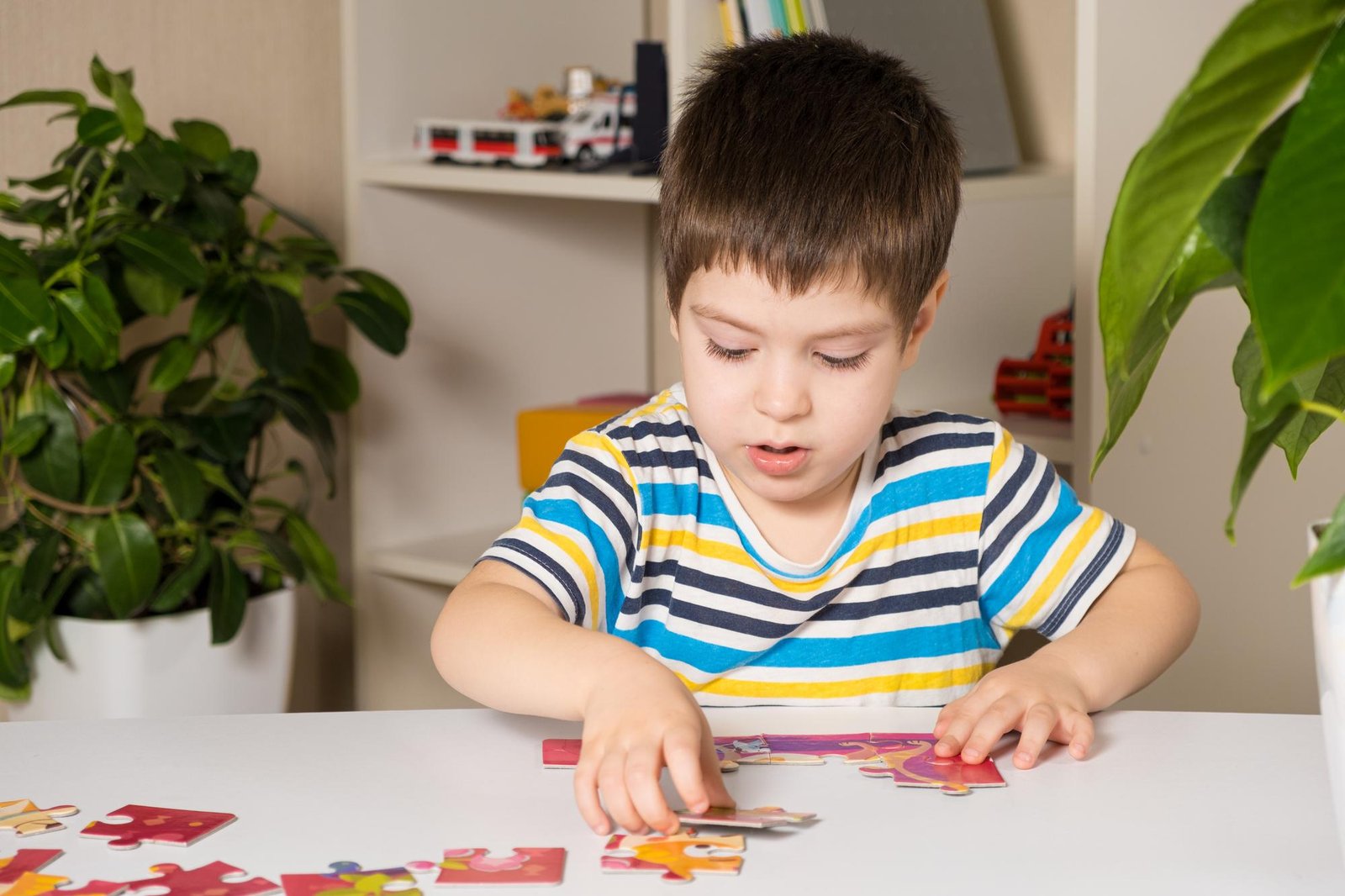
3. Put movement and play before seated work
Many children focus better after they move, not before. Play is not a distraction from development; it is part of development.
The AAP states that play helps build executive functioning, including working memory, flexible thinking, and self-regulation, and that children use those skills to follow directions, solve problems, and pay attention. (6)
This is why a child may do better after:
- a short walk
- jumping jacks
- animal walks
- dancing to one song
- throwing and catching a ball
- a quick balance game
If you are working with a younger child, play-based attention building is often more appropriate than trying to force long desk-based practice.
For preschool-aged children especially, routines, play, and parent-led behavior support should come before overcomplicated productivity systems. (5)
4. Give one instruction at a time and praise the behavior you want repeated
Distracted children often hear only part of what you say. Long chains of instructions can overwhelm them before they even start.
Instead of giving three or four directions in a row, try one clear instruction at a time.
For example, say:
“Put your shoes by the door.”
Then pause.
Then say:
“Now bring your notebook.”
HealthyChildren recommends describing and praising the behaviors you want to see more of.
Examples include specific praise like “Good job listening the first time” and “Good job using your inside voice.” (6)

That same approach works beautifully for attention:
“Nice job getting started right away.”
“Good work staying with that for three minutes.”
“I like how you came back after getting distracted.”
Specific praise teaches children what success looks like.
Vague praise like “good job” is less useful than praise that names the exact behavior.
5. Make screen time intentional, not automatic

Screens are not automatically harmful, but they work best when families use them intentionally. HealthyChildren recommends a thoughtful family media approach and describes the “5 C’s” of media guidance as a way to think about the child, the content, calming down, what media is crowding out, and ongoing communication. (5)
For younger children, quality and parent involvement matter a great deal. For older children, it can help to ask not just “How much screen time is this?” but also “What is the child doing, for how long, and for what purpose?” (5)
A practical family rule is this: use screens on purpose, not by accident. That means choosing a specific activity, a clear time limit, and a reason for using it. (5)
6. Track progress in small, visible ways
Parents often miss improvement because they are looking for a dramatic overnight change. Focus usually grows in small steps.
A child who could stay with a task for two minutes last week and four minutes this week is improving, even if they are not yet where you want them to be.
You can track progress with a simple note on paper or in your phone:
How long did the child stay with the task?
How many reminders did they need?
Did they return after getting distracted?
What helped most: movement, snack, timer, quieter room, or shorter instructions?
This kind of tracking gives you something valuable: patterns. It also gives you a calmer way to notice progress instead of judging every day emotionally.

7. Use digital tools as practice tools, not miracle solutions
This is where many parents get stuck. They want help from technology, but they do not want more aimless screen time.
A more balanced approach is to use digital tools the way you might use a timer or a short drill: as a brief, structured activity with a clear beginning and end. (5)
On Google Play, Reflex Builder is described as a timing and precision game built around a one-touch mechanic: the player charges an energy ring and releases at the right moment to hit the target.
Its Play listing highlights focus, reaction, timing, tier-based progression, and a memory mode at higher levels. The app is rated 3+ on Google Play. (7)
A practical way to use a digital tool like this is to keep it short, structured, and clearly bounded — for example, after movement, before homework or reading, and with a clear stop point.
The goal is not perfection. The goal is consistent practice inside a broader routine that also includes sleep, movement, play, and parent support. (7)
That means the safest and most credible way to position it in parent content is this:
- not as a treatment
- not as a diagnosis tool
- not as a replacement for outdoor play, sleep, therapy, or school support
but as one parent-supervised, short-session practice option for school-age children who benefit from structured response-and-timing tasks
A practical way to use it would be:
- 3 to 5 minutes
- after movement
- before homework or reading
- with a clear stop point
- with the parent tracking effort, not perfection
That keeps the tool in its proper place: supportive, measurable, and realistic.
When to seek extra help
If your child’s attention problems are persistent, significant, and showing up across home, school, and other settings, it is a good idea to talk with your pediatrician or another qualified professional.
CDC guidance says that for children younger than 6 with ADHD, parent training in behavior management is recommended as the first line of treatment before medication.
For children 6 and older, behavior therapy remains important, and schools can be part of support as well. (7)
It is also worth reaching out sooner if you notice:
- major struggles with learning
- frequent inability to follow even simple instructions
- extreme impulsivity or unsafe behavior
- concerns from teachers
- developmental delays beyond attention alone
The right next step is not panic. It is better information and better support.
A realistic way to think about focus (How to help my child focus at home?)
Helping a child focus is usually less about finding one magic trick and more about building an environment where focus is easier.
Predictable routines, movement, play, specific praise, manageable instructions, and thoughtful use of digital tools can work together to make focus easier.
HealthyChildren supports routines and positive behavior shaping, while the AAP notes that play helps build executive functioning skills such as working memory, flexible thinking, and self-regulation — skills children use to follow directions and pay attention. (7)
HealthyChildren emphasizes routines and positive behavior shaping, and the AAP highlights that play supports the exact self-regulation and executive-function skills children need for attention and learning. (7)
So if your child is struggling, start small.
- Make the task shorter.
- Make the routine clearer.
- Praise the effort you want repeated.
- Use screens on purpose.
- Track progress weekly.
If you want to add one short digital practice block to your child’s home routine, use it alongside movement breaks, predictable routines, and positive behavior support.
Used that way, a simple digital tool can fit into a broader home focus routine rather than replacing the basics that children still need. (7)
Frequently Asked Questions
How long should a child be able to focus?
It depends on age and the kind of task. For example, the CDC includes paying attention for about 5 to 10 minutes during activities like story time or arts and crafts as a milestone by age 5, and it specifically notes that screen time does not count. (1)
Can games help children build focus?
Games can be useful as a practice tool when they are short, structured, and used on purpose. They work best as one part of a bigger routine that also includes sleep, movement, play, parent coaching, and realistic expectations. (6)
Is my child just active, or could it be ADHD?
Some children are naturally energetic, but ADHD involves patterns of inattention, hyperactivity, and/or impulsivity that interfere with daily functioning.
A diagnosis also depends on symptoms being present in more than one setting and lasting long enough to meet clinical criteria, so it is best discussed with a qualified professional. (3)
What is the first thing parents should try at home?
Start with a better routine. HealthyChildren supports regular, predictable, consistent routines, and CDC behavior guidance for ADHD also recommends creating a routine and following the same schedule for everyday tasks. (1) (2)
Can I use Reflex Builder for my child?
Reflex Builder is rated 3+ on Google Play and is described there as a timing and precision game focused on reaction, timing, focus, and tier-based progression. (7) (8)
References
1 – CDC – Milestones by 5 Years
2 – CDC – Treatment of ADHD
3 – NIMH – ADHD: What You Need to Know
4 – HealthyChildren – The Importance of Family Routines
5 – HealthyChildren – Kids & Screen Time: How to Use the 5 C’s of Media Guidance
6 – AAP – Power of Play in Early Childhood
7 – Google Play – Reflex Builder Precision Game
8 – Reflex Builder – Google Play Developer Program Policies Compliance
9 – Reflex Builder Privacy Policy
Click Here To Improve Your Response and Reaction Time. (Link to download Fast Reflex Improvement Game for Android from Google Play Store) (focus games for young children)